There is a bookshop at the end of a quiet street, and in that bookshop there is a fire, and near the fire there is a perch, and on the perch there is a parrot.
The parrot does not comment on squirrels. He has opinions, but he keeps them to himself. He has always kept them to himself. It is one of the things Lionel respects most about him.
The door of the bookshop opened.
Two things happened, as they always do: the street noise stayed outside where it belonged, and Lionel’s voice was already in the middle of a sentence.
He was up on the library ladder — quite high, one large hand resting on a shelf, the other holding nothing at all, because he did not need anything in front of him. He was talking about acorns.
The children stopped in the doorway.
The fire was exactly the right size. The parrot was on its perch by the fire, in the way that suggested it had always been there and intended to remain so. On a low table between two pillows — worn denim pillows, old and soft, with animals stitched into the patchwork, a fox here, a sparrow there, a small determined squirrel in the corner of one that several hundred children had sat on without ever noticing — there was a small candy dish.
The dish was full of sunflower seeds.
One of the children reached for a seed, the way you reach for something when you think no one is looking.
From up on the ladder, without looking down: “Those are relevant to the story.”
He continued talking. They found the pillows. They sat.
They were just in time. They were always just in time. That is how this bookshop works, though Lionel has never explained it, and the parrot, as usual, is not saying.
“Now,” said Lionel, from his perch on the ladder, which is where he does his best thinking. “I should tell you a few things before we begin. The first thing is about acorns.”
He looked at them over the tops of his glasses — he had glasses today; he did not always — with the expression of someone about to share information of the highest importance.
“A gray squirrel,” said Lionel, “can bury as many as ten thousand acorns in a single autumn.”
He let that sit.
“Ten thousand. Do you know how long it would take you to count to ten thousand? If you counted one number every second, without stopping, without sleeping, without lunch — it would take you nearly three hours. That is how many individual acorns. Each one carried in the mouth. Each one buried in a separate spot. Each spot remembered.”
He held up one finger.
“Mostly remembered.”
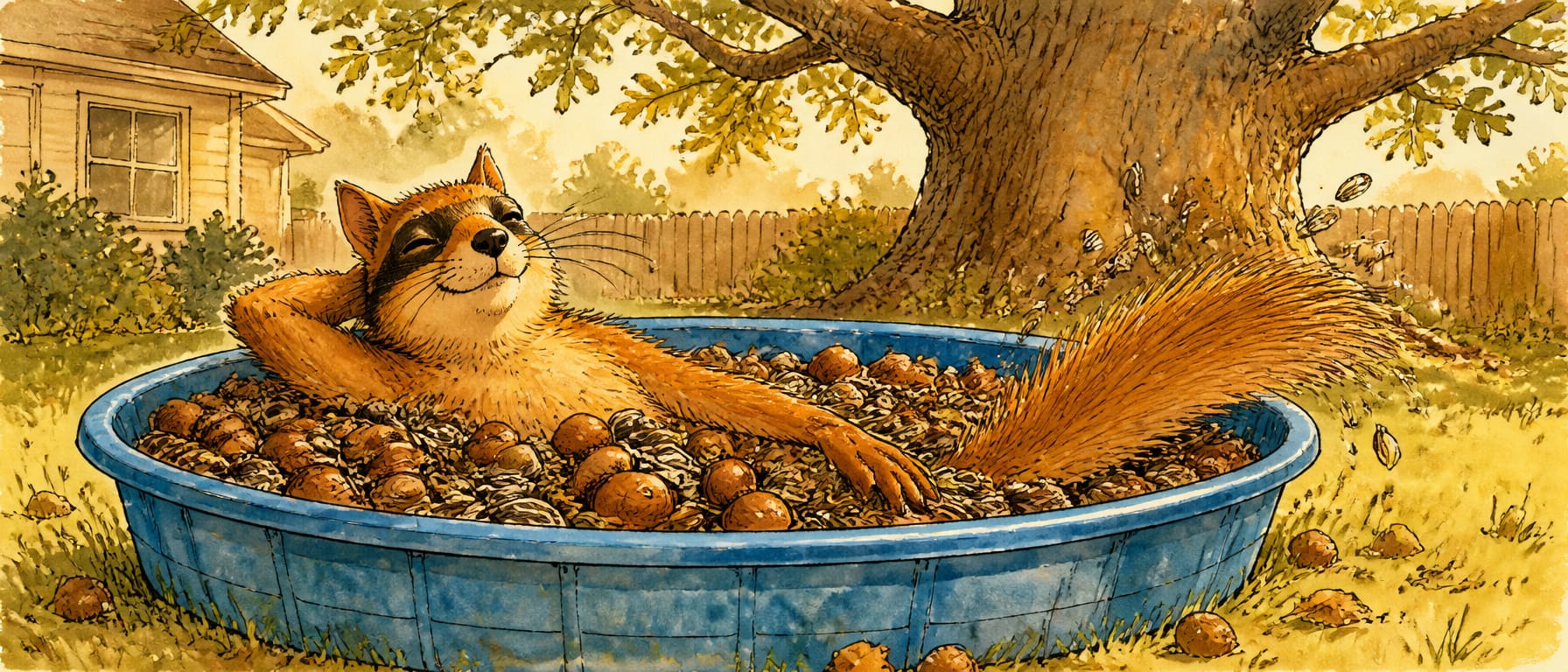
“You see, a fox squirrel can fill his cheek pouches with enough food to equal nearly a fifth of his own body weight. If you could do this — and I want to be clear that you cannot, and should not try — you could carry, in your cheeks, roughly the weight of a very full school backpack. Entirely in your cheeks. Going home.”
“He looks,” Lionel added, “extremely pleased with himself. As he should.”
“Now. Here is the part I want you to think about.”
He leaned forward on the ladder, just slightly, in the way that meant the next sentence mattered.
“He forgets roughly a third of them.”
A pause of the exact right length.
“Not because he is careless. He is not careless. He is caching thousands of individual acorns in hundreds of locations across a territory the size of several football fields, using nothing but memory. He remembers most of them. Most. But the ones he doesn’t —”
Lionel glanced toward the window.
“There is an oak forest on Pemberton Avenue that would like to thank him.”
He waited, watching the thought land.
“He didn’t plant that forest. He never meant to. He was simply trying to feed his family, and he forgot some acorns, and the acorns didn’t forget to become trees. That forest is one hundred and forty years old. The squirrel who planted it — without knowing he was planting it — was born the year President Lincoln was shot. He had no idea. He was just hungry.”
“His forgetting,” said Lionel quietly, “is why that forest exists.”
“The squirrel I want to tell you about,” he continued, beginning to descend the ladder one unhurried rung at a time, “had thought about this. And he had concluded that the bird feeder at number forty-seven Oak Street was a better proposition than frozen ground and imperfect memory.”
He reached the bottom of the ladder and settled into his chair the way he always settles — heavily, comfortably, as though the chair had been waiting for exactly him.
He picked up one sunflower seed from the candy dish. Held it up.
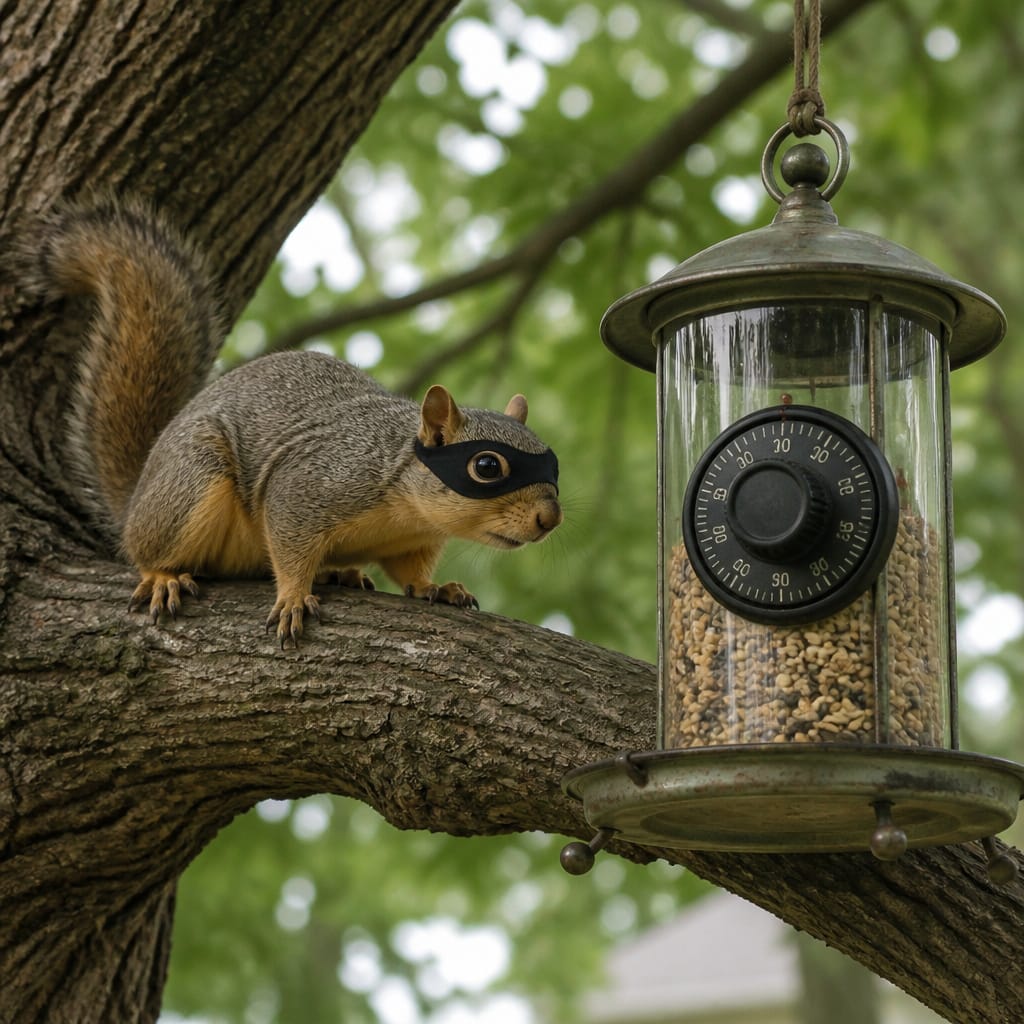
“His name, in the neighborhood, was Bandit.”
“The mask,” Lionel added, “came standard. It is not an affectation. He was simply born looking like that. He grew into it.”
“Now,” said Lionel. “Before we discuss the bird feeder — and we will discuss the bird feeder, at some length — I think you should know what Bandit was working toward.”
He folded his hands.
“In a hollow in a very large oak tree on the corner of Oak Street and Maple Avenue — which is, I grant you, a street name of limited imagination — there lived a family.”
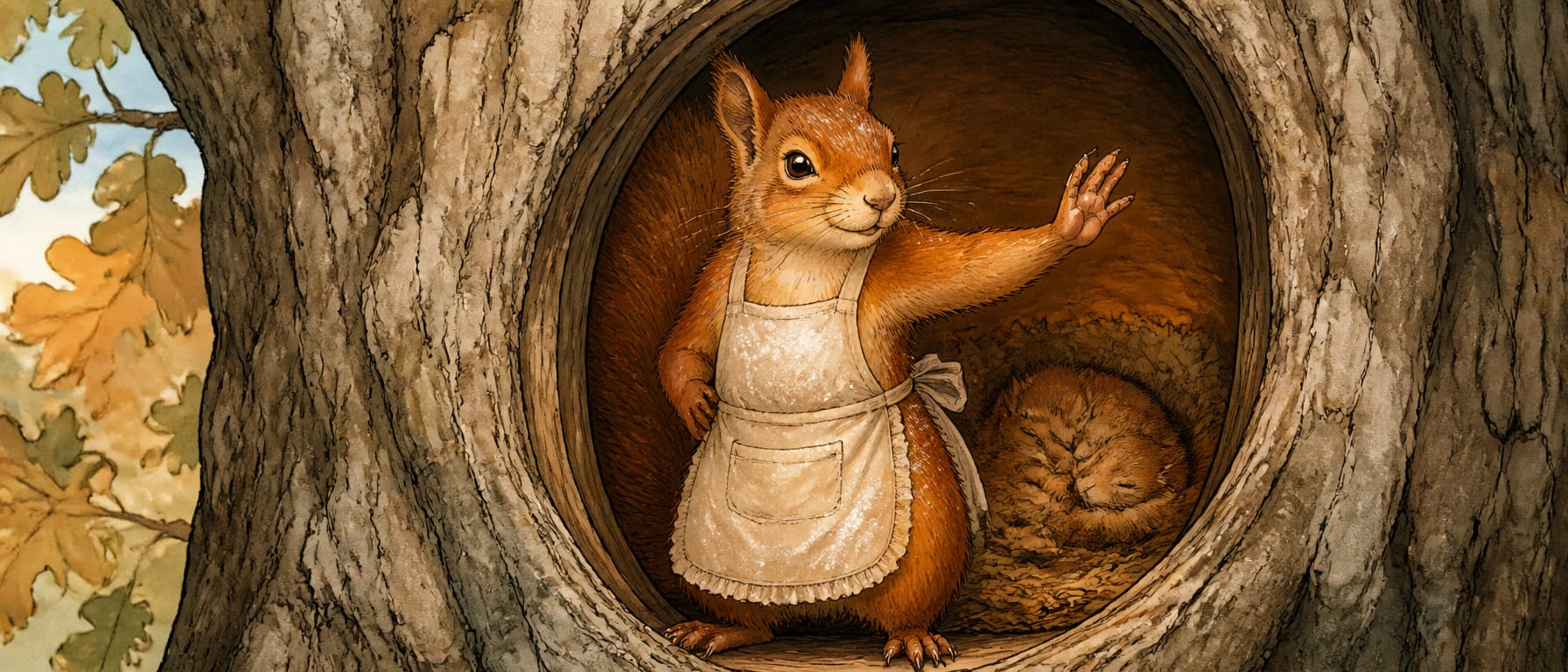
“Mrs. Squirrel had, at last count, three kits. Small ones. Brand new. At this stage in their lives, kits have two modes available to them: asleep, and eating. They cycle through these modes with great efficiency and absolutely no consideration for what their father might be going through on their behalf.”
He picked up a sunflower seed from the dish, turned it in his fingers.
“Fox squirrel kits are born without fur, without teeth, and without any opinion of their own yet. By six weeks, they have fur. By eight weeks, they have opinions. You will recognize this development pattern.”
A small pause, in which several children appeared to think about this.
“Mrs. Squirrel was keeping the kits warm. This was her job. She was very good at it. She was, by any measure, the sensible one.”
“She had, over the course of their marriage, developed a theory about Bandit.”
Lionel set the seed back in the dish with great care.
“Her theory was that her husband was,” and here Lionel paused in the particular way that means the next word matters, “a little nuts.”
He looked at the children over his glasses.
“She is a squirrel. I want you to understand that she meant this sincerely, and not as a joke.”
Pause.
“I’m not entirely sure the universe sees it that way.”
“What she did know — what she had always known, through every winter they had shared together — was that the kits were always fed. The hollow was always warm. The larder was never quite empty, even in February, even in the hard years when the ice came early and the acorns ran thin.”
“He always came home before dark. He always came home with his cheek pouches full.”
“She didn’t have a bandit mask, of course.”
Lionel said this as though it were a perfectly straightforward operational fact.
“That was his department.”
“Now. Before we get to the feeder itself — and I promise we are getting there — you should know a little about where Bandit came from.”
“He is a fox squirrel. The largest of the tree squirrels in North America. Reddish-brown, quick, clever, and considerably better at solving problems than the feeder’s manufacturer had apparently assumed. But he has family, as we all do, and his family is worth knowing.”
Lionel settled back slightly.
“His cousin — the one nobody in the family quite knows what to make of — is the flying squirrel.”
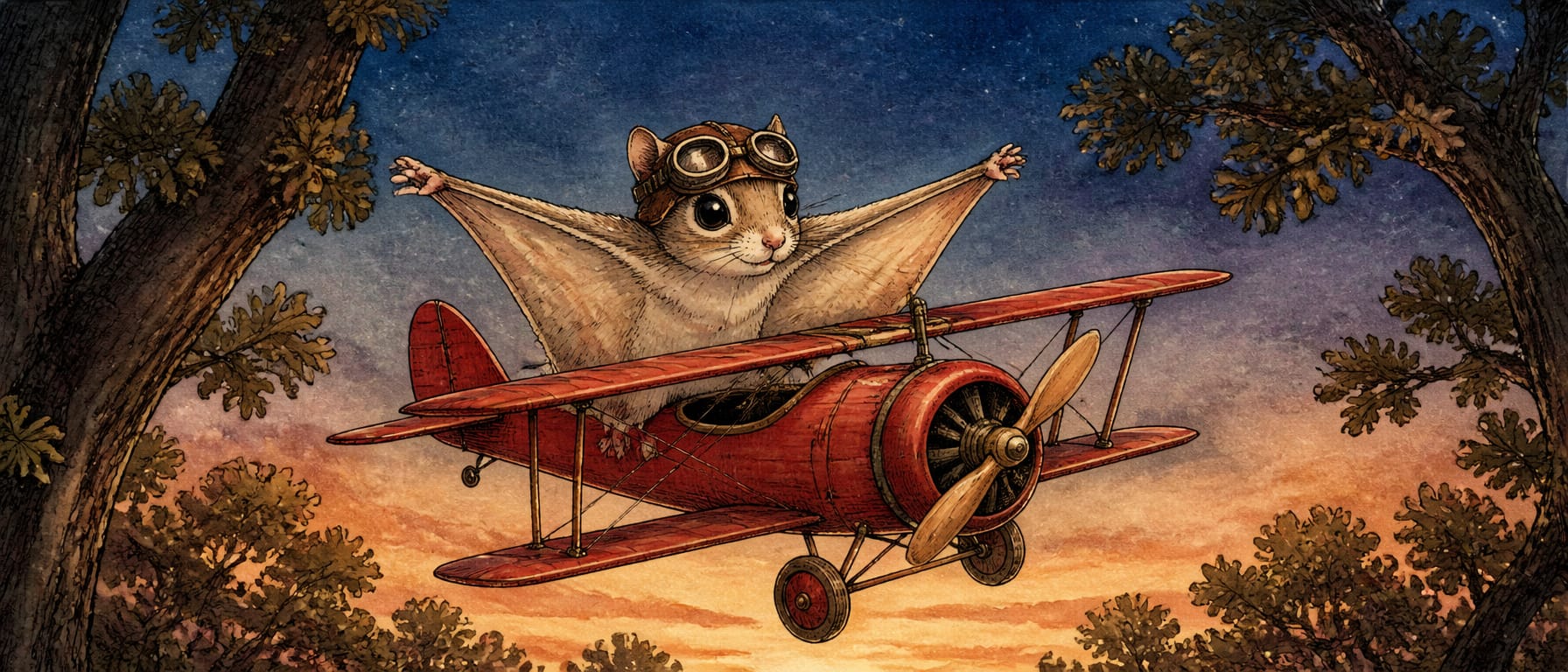
“The flying squirrel does not, strictly speaking, fly. What he does is glide. He has a thin fold of skin — called a patagium, if you want the word — that stretches between his wrists and his ankles, and when he leaps from a tree, he spreads himself wide and drifts, silent as paper, through the dark air. He can cover the length of a football field in a single glide. From a standing start. In complete silence. In the dark.”
“He only comes out at night. He has enormous eyes — larger, proportionally, than a cat’s — built for seeing when there is almost no light at all. He moves through the forest like a small friendly ghost. Most people have lived their entire lives thirty feet from a flying squirrel colony and never known it.”
“Bandit finds him unnecessarily dramatic.”
A beat.
“Then there is the grandfather. The red squirrel.”
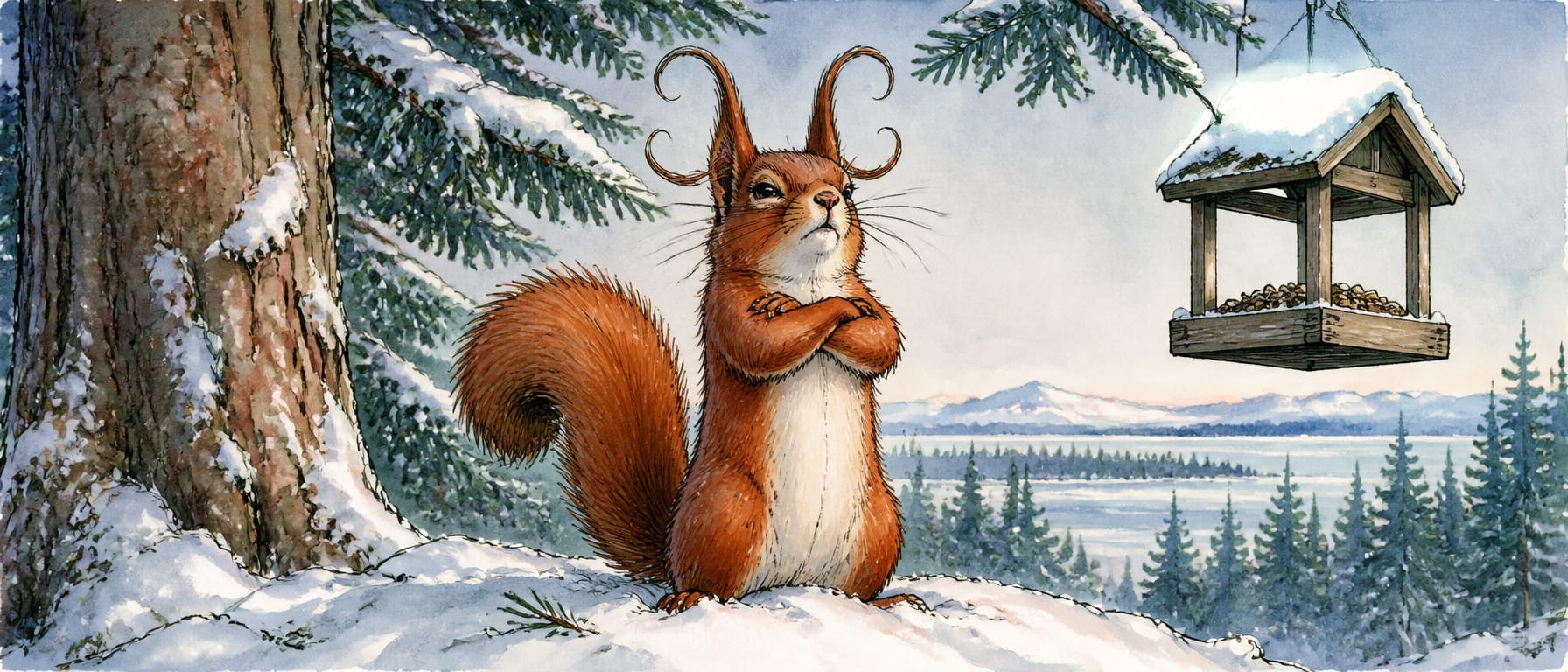
“You have almost certainly seen a gray squirrel. The red squirrel is not a gray squirrel. The red squirrel is, pound for pound, the most opinionated animal in North America. He is small — not much bigger than your fist — but what he lacks in size he more than compensates for in certainty. He is certain about most things, and wrong about very few of them, and he knows both of these facts, which makes him quite difficult to argue with.”
“In winter, he grows ear tufts. Long pointed tufts of fur that stick straight up from his ears and that make him look, at all times, as though he has just been told something he finds personally offensive. He has stood next to a feeder his whole life. He knows exactly what feeders do and do not do, and he would like to tell you about it, and he will, whether or not you asked.”
“He tried this exact feeder, in fact, in 1987.”
“He knows how it ends.”
“He mentioned this to Bandit.”
“At some length.”
“Bandit,” said Lionel, “listened respectfully, and then went back to work.”
“Now,” said Lionel, and his voice did something it sometimes does — gathered itself, like weather.
“Every quest needs a map.”
He reached into the pocket of his jacket — the large one, the one that seems to hold more than it should — and produced a small folded piece of paper. He unfolded it carefully on his knee. It was slightly chewed at one corner.
“Bandit,” said Lionel, “is a squirrel of method. Before setting out each morning, he consulted his map. The map showed the oak tree — that is home, that is the start — and the yard, and the fences, and the routes between the branches, and the feeder at the far end, which he had labeled, in small but determined scratches:”
He tilted the paper toward the children.
“The Fortress.”
“And here — do you see — in the corner of the map, next to the oak tree, there is a small mark. A paw print. And beside it, something that might be — though the paper is somewhat worn — a kiss.”
He folded the map again. Set it on the table beside the candy dish.
“Before he set out each morning, Mrs. Squirrel kissed him goodbye. She would say, if you asked, that she did this because he was blocking the entrance to the hollow and she needed him to move along.”
Pause.
“The kits watched. They do not have opinions yet — they are very small and opinions come later — but they watched with their small new eyes in a way that suggested they were noting everything down.”
“Bandit went down the tree a little taller each time.”
“He would not say so. But he did.”
“In the Arthurian tales — the great ones, the ones that have lasted a thousand years — the knight sets out and the world sets obstacles before him. Not because the world is cruel. Simply because that is what worlds do to knights. It is, in a sense, a form of respect.”
“The yard between the oak tree and the Fortress had four obstacles. Five, if you count the owl, and you must always count the owl.”
“Bandit counted. He always counted.”
“The First Trial: The Dragon of the Air.”
“In the old stories there is always a dragon.”
“Ours has a wingspan of four feet, and talons that close with the force of a steel trap, and a screaming cry that has been described as the sound of a small trombone being very surprised. The red-tailed hawk lives three streets over and considers this entire neighborhood to be his.”
“He circles. He is patient the way only things that hunt from the sky can be patient. He is in no hurry. He has all day.”
“A good knight knows his dragon. Bandit’s rule, unbreakable, always: never be in the open for more than four seconds.”
“One. Two. Three. Four.”
“Then he is behind bark, or under a branch, or very still in the shadow of something larger, and the hawk circles on, and finds other business.”
“He counts every time. Without fail. Without exception.”
“Even on the days when he is in a hurry.”
“Especially on those days.”
“The Second Trial: The Serpent.”
“Every quest has its serpent.”
“In the old tales it guards a garden, or a treasure, or the only road that leads where you need to go. Ours is a black rat snake, six feet long, and possessed of a skill that most people forget snakes have, because it is unsettling and they would prefer not to think about it.”
“It climbs.”
Lionel let this land.
“The snake climbs trees. It has been climbing trees for a very long time. It is extremely good at it. It moves through the branches quietly, looking for — well. Looking for the kinds of things that live in hollows in oak trees.”
“This,” said Lionel quietly, “is why the map matters. This is why the kiss matters. This is why Bandit goes out each morning so that other things do not have to.”
“The serpent has its own part to play in the yard. It eats mice, and rats, and keeps the garden in a kind of balance. It is not a villain. It is simply the world doing what worlds do.”
“But a knight knows where the serpent walks. He does not use the low branch on the south side of the cedar. Not since April. He updated the map.”
“The Third Trial: The Herald Who Will Not Let You Pass.”
“In every quest,” said Lionel, with great seriousness, “there is a guardian. Not powerful. Not evil. Simply convinced — absolutely, completely, and without any evidence whatsoever — that you are not welcome here and they are going to tell you so.”
“The mockingbird weighs approximately one and a half ounces.”
He looked at the children.
“Bandit weighs approximately two pounds.”
“The mockingbird is not aware of this. Or it is aware of it and has decided it doesn’t matter. The effect is the same either way.”
“It comes from above — not like the hawk, not with patience and silence — but with noise. Considerable noise. It dive-bombs. It screams. It has approximately forty-seven different calls, and it uses all of them, one after another, at Bandit, without stopping, for as long as it takes.”
“Bandit ducks. Bandit weaves. Bandit does not strike back, because a knight does not fight an opponent this size, not because he couldn’t but because there would be absolutely no honor in it and everyone would hear about it.”
“He ducks. He moves on. The mockingbird declares victory.”
Pause.
“Every day.”
“Every single day, the mockingbird declares victory.”
“Bandit is halfway to the feeder.”
“The Fourth Trial: The Enchantress.”
Lionel’s voice went quieter here. Not darker. Quieter.
“Between two branches of the cedar tree — on the most direct route, in the exact spot that would save Bandit four full seconds — there is a garden spider.”
“She has been there since August. Her web is, and I want to be accurate here, a genuine marvel of engineering. She has built spiral threads and radial supports and a signature zigzag pattern down the center — engineers call that a stabilimentum — that she renews every single night. Every morning: perfect. Every morning, without fail.”
“She has never bothered anyone. She is simply there, in the most inconvenient possible location, doing extraordinary work and minding her own business entirely.”
Lionel looked at the children.
“Bandit stops.”
“Every time. Completely. Whatever he was thinking about, whatever the hawk is doing, however long the route around will take — he stops.”
“He looks at the web.”
“He goes around.”
A beat of the exact right length.
“He is very brave,” said Lionel.
Another beat.
“About most things.”
“And then,” said Lionel, “there is the one that does not appear on the map.”
“Because the map is for the daytime. And what I am about to describe does not operate in the daytime.”
The fire in the grate did something it almost never does — not dimmed, exactly, but seemed to take a breath.
“The Barred Owl.”
“It flies on wings that make no sound. No sound at all. The feathers along the leading edge are soft and comb-like, designed by ten million years of nighttime hunting to cut through air without a whisper. It can hear a mouse moving under six inches of snow. It turns its head nearly all the way around, because when you are that patient and that silent, you can afford to look anywhere you like.”
“And it calls.”
“In the dark. From the tall trees. In a voice like a question that expects an honest answer:”
Lionel paused.
From somewhere outside the bookshop window — faint, distant, possibly just the wind doing something odd in the chimney — came a sound.
Who cooks for you.
Who cooks for you-all.
The parrot’s feathers moved. Just slightly. Just once.
Lionel did not look toward the window. He did not look toward the parrot. He continued in the same voice, without a pause:
“This is why Bandit is always home before dark.”
“The quest — the map, the hawk, the serpent, the mockingbird, the spider — all of it takes place between sunrise and sunset. Between the kiss at the door of the hollow and the moment he comes home, pouches full, in the last of the light.”
“The owl’s question rings through the dark long after he is safely inside.”
“She hears it sometimes, settling the kits.”
“She pulls them a little closer.”
“She does not say anything about it.”
“Neither does he.”
“Now,” said Lionel. “The Fortress itself.”
“The bird feeder at number forty-seven Oak Street was, when this story begins, a handsome thing. Glass and brass. A generous perch. And on its face, installed by a homeowner who had done his research and was feeling, I think it is fair to say, rather pleased with himself —”
Lionel held up one finger.
“— a combination lock.”
“The same homeowner had placed a small sign on the shepherd’s hook from which the feeder hung. The sign said: SQUIRREL PROOF.”
Lionel looked at the children over his glasses.
“I’m not sure the sign-making people consulted with any squirrels.”
“The First Trial: The Reconnaissance.”
“Bandit studied the feeder for three days before he touched it.”
“He sat on the branch of the oak — close enough to see, far enough to think — and he watched. He watched the chickadees land, take a seed, depart. He watched the combination lock. He watched the homeowner come out each morning to check that everything was, as the sign suggested, proof.”
“On the fourth day, he approached. He reached out one paw — carefully, professionally — and tried the dial. Left. Right. Left.”
“A combination lock on a bird feeder presents a certain problem, which is that a squirrel cannot dial in three numbers. His paws are not built for it. This is simply engineering. Bandit understood this. He was not discouraged. He was gathering data.”
“He prodded. He pushed. He applied his weight to the perch at a specific angle, twice, and then sat very still and thought.”
“And then — because patience is the first tool, and Bandit had it in considerable supply — he found the gap.”
“Not the combination. Not the lock. A small gap at the base of the perch where the glass met the brass fitting. Just large enough, just barely, for a fox squirrel with determination and a very particular angle.”
“He filled his cheek pouches. Not full. Not nearly. A modest haul. A proof of concept.”
“He went home.”
“The next morning, the homeowner added a cage around the outside of the feeder.”
“Bandit studied the cage for one day. He went home. He thought. He consulted the map. He added a new mark. Then he placed an order.”
“Three days later,” said Lionel, “at the base of the oak tree, there was a small brown cardboard box.”
“It was addressed to B. Squirrel, The Oak, Oak Street and Maple Avenue.”
“The delivery driver had left it without further comment. This says something, I think, about the era we live in.”
“The instructions were printed in twelve languages. None of them were Squirrel. The pictures, however, were very clear.”
“He left a review afterward. Four stars. He would have given five, but the battery life was inconsistent in cold weather, and Bandit believes in honest feedback.”
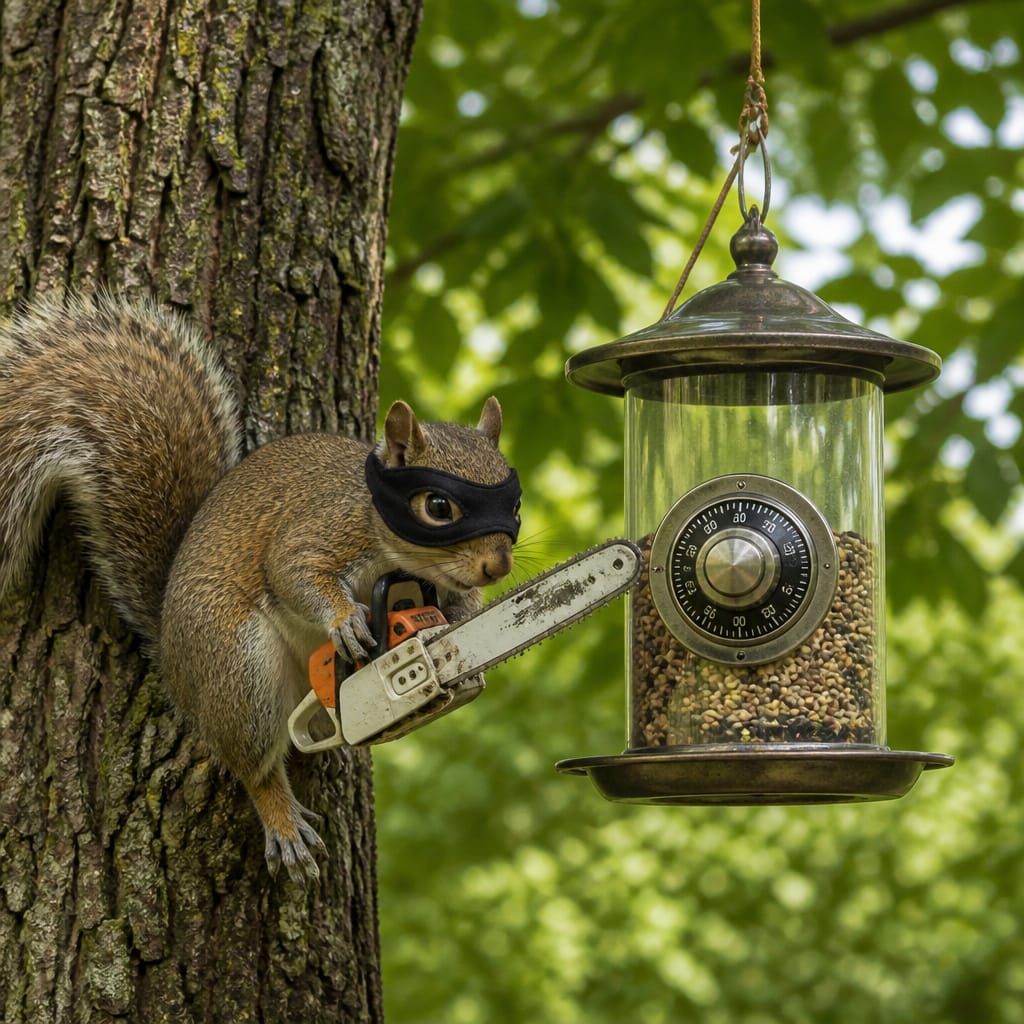
From somewhere outside the bookshop window —
Very small. Very brief. Very determined.
A sound.
Like a tiny saw.
Then gone.
The children looked at each other.
The parrot opened one eye. Looked at the window. Closed the eye again.
Lionel continued, without looking up:
“The Second Trial: The Direct Approach.”
“The cage,” said Lionel, “did not survive the morning entirely intact. I want to be fair to the homeowner: it was a good cage. Heavy gauge wire. Professionally installed. Under ordinary circumstances, it would have been more than adequate.”
“These were not ordinary circumstances.”
“Bandit retrieved what he could through the gap while the cage was — let us say reorganized. The haul was considerably larger than the first trial. Not a full victory. But progress.”
“The homeowner came out to check the feeder that afternoon. He stood looking at it for a long time. He went inside. He came back with a second lock. And a baffle — that is a wide slippery disk around the pole, designed to stop things from climbing — and what appeared to be a length of steel cable.”
“He was not, I think, feeling pleased with himself anymore.”
“He was feeling something else.”
Lionel considered.
“Determined.”
“Bandit, watching from the oak tree, recognized the feeling. He respected it. He updated the map. Then he went and sat in the pine tree across the street to think, because sometimes a different tree gives you a different thought.”
“And that,” said Lionel, “is when the distant cousin arrived.”
“He arrived in the pine tree across the street on a Tuesday morning in October. Gray-brown, roughly the same size as Bandit. But with a stillness about him — a particular quality of stillness that you do not learn in this neighborhood, or this city, or, if I am being accurate about it, anywhere in this general part of the galaxy.”
The parrot’s head rotated, very slightly, toward Lionel. Then back.
“He stayed for one week. There were demonstrations. There was training. There was, apparently, a considerable amount of sitting in trees and becoming very quiet inside — which Bandit had been doing his whole life, it turned out, without knowing it had a name.”
“There were discussions about patience. About the gap between wanting a thing and reaching for it. About how the best approach is sometimes not the most obvious one, and the most obvious one is sometimes a trap set by the combination lock for someone who is in a hurry.”
“Bandit,” said Lionel, “is a good student when the subject interests him.”
“On the following Tuesday, the cousin climbed to the very top of the pine tree, paused for a moment on the highest branch —”
Lionel looked at the children.
“— and leaped.”
“He was gone before he reached the other side of the street. The pine tree still has a small scorch mark on the top branch. The delivery of the package he left in the hollow took three days and came, as far as anyone can tell, from nowhere that appears on any map Bandit has ever drawn.”
“It was purple.”
“Mrs. Squirrel, when Bandit brought it home: ‘What is that?’”
“Bandit,” said Lionel, “did not explain.”
“She thinks he is a little nuts.”
Pause.
“She is not entirely wrong.”
“She is not entirely right either.”
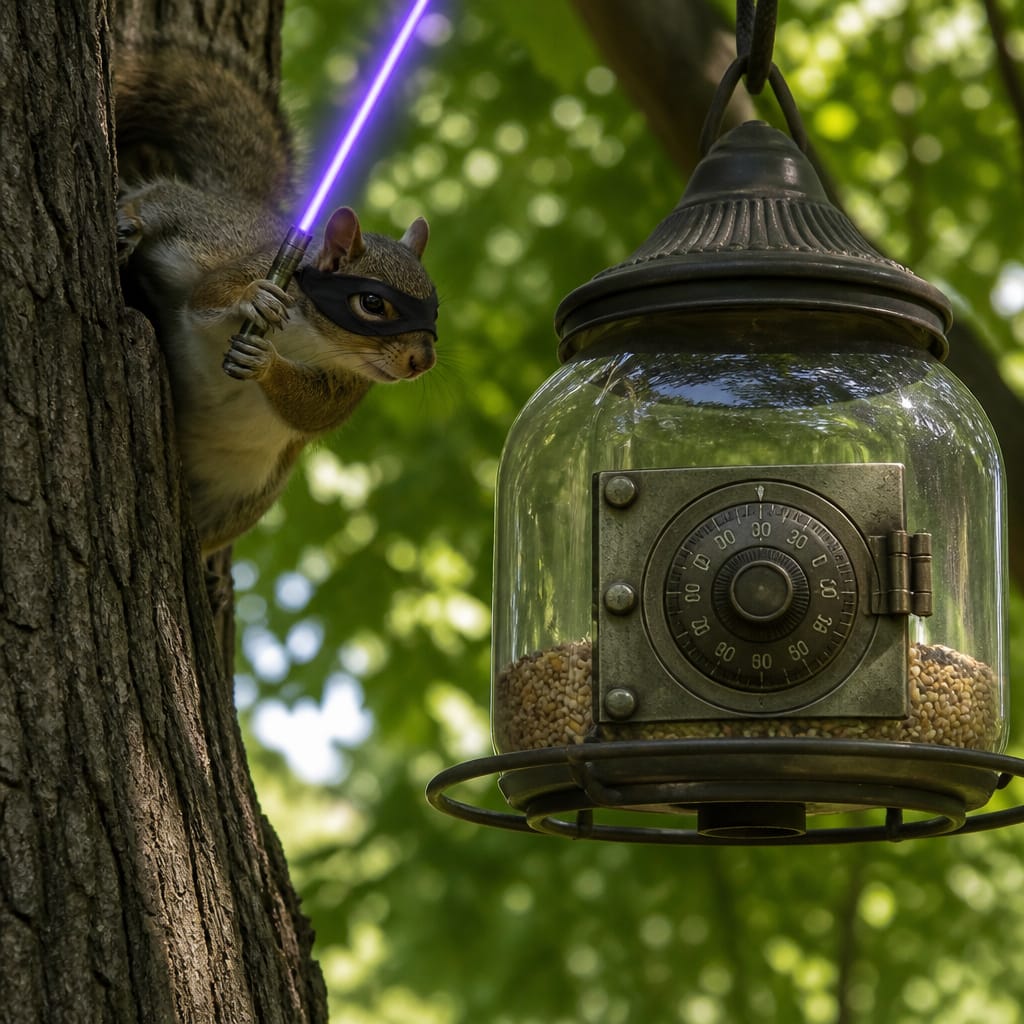
“The Third Trial: The Advanced Methodology.”
“By this point,” said Lionel, “the Fortress was formidable. There was the original combination lock. There was the second lock. There was the cage — repaired and reinforced. There was the baffle on the pole. There was the steel cable. There was a new sign, which the homeowner had written himself this time, in larger letters.”
“The sign said: I MEAN IT.”
Lionel said this with complete respect.
“Bandit studied the Fortress for one morning. He sat on the branch. He was very still. He thought about patience. He thought about the gap between wanting and reaching.”
“Then he took out the gift from the pine tree.”
The children were very still on their denim pillows.
From somewhere outside the window — faint, and then not so faint, and then the particular sound that is not quite like anything else in the world —
A hum.
Low. Resonant.
And at the glass, for just a moment, a color.
Purple.
Just the streetlight, probably.
The parrot did not open its eye this time. It opened both eyes. Then closed them. Then appeared to go to sleep with an expression of deep deliberate neutrality.
Lionel continued. He did not look toward the window. He did not look toward the parrot.
“The result of the Third Trial was as follows.”
“The Fortress survived. I want to be clear about this. The homeowner’s engineering held. The locks held. The cage held. The baffle held. The cable held.”
“And yet.”
He reached forward and picked up one sunflower seed from the candy dish.
“The Fortress was, the following morning, measurably lighter.”
“The combination lock, when the homeowner checked it — and he checked it very carefully — was set to three. Fourteen. Twenty-seven. He did not set it to three, fourteen, twenty-seven. He does not know who did.”
“He put up a third sign.”
Lionel smiled.
“It just says: HOW.”
Lionel reached forward and picked up one sunflower seed from the candy dish.
He held it up. He looked at it for a moment. He looked at the children.
“You have eaten,” he said, with the mildness of someone making a simple mathematical observation, “eleven of these.”
He let that sit.
“I’m not going to tell you that was a mistake. Sunflower seeds are an excellent source of fat and protein and winter fuel, and if you were a fox squirrel heading into January, I would call it excellent planning.”
“You are not a fox squirrel heading into January. But the principle holds.”
He turned the seed in his fingers.
“The Fortress holds, when full, somewhere between four and five thousand of these. Bandit is one squirrel. The kits are three. Fox squirrels do not fully hibernate — they sleep through the worst of the cold, but they wake, and they are hungry when they wake, and winter is long.”
“He brought home, across the three trials, a good day’s worth.”
He set the seed back in the dish with great care.
“He was home before dark. He counted to four in the open, every time. He went around the spider. He did not engage with the mockingbird on points of principle, which takes more discipline than it sounds.”
He folded his hands.
“There is something I should tell you about Mrs. Squirrel.”
“She was in the hollow when he came home. She was keeping the kits warm. She has, as you know, a theory about her husband. Her theory — and she holds it sincerely, and with love, in the way you can love someone and still have a very accurate theory about them — is that he is, to use her word, a little nuts.”
“She does not know about the hawk rule. She does not know about the map, or the cousin from the pine tree, or the combination lock set to three, fourteen, twenty-seven, or what it takes to fight your way through November with a lightsaber and a sense of professional obligation.”
“She knows he came home.”
“She knows his pouches were full.”
“She knows the kits are warm.”
Lionel looked at the children over his glasses.
“She means this, I believe, as a criticism.”
The longest pause of the evening.
“The universe may have a different view.”
“The feeder has four thousand seeds remaining, approximately. Winter is eleven weeks long, approximately. He has the map. He has the gap in the glass fitting. He has the rule of four seconds, and the knowledge of where the serpent walks, and a healthy respect for the spider that has earned it.”
“And he has, in the corner of the map next to the oak tree, something that is harder to put into words.”
Lionel paused. When he spoke again his voice had not changed. He was still doing the arithmetic.
“A paw print,” he said. “And a kiss.”
He said nothing else for a moment.
“You may want to check the feeder in the morning.”
The children gathered themselves, the way children do when a story has ended and the room is coming slowly back. The denim pillows. The fire. The candy dish, a little less full than it had been.
At the door, one of them turned.
The parrot was on its perch.
It was not looking at the children.
It was not looking at Lionel.
It was looking at the window. At the glass, where the streetlight made a long pale shape and the dark street pressed against the other side.
It was watching.
It was not, under any circumstances, saying.
The door opened. The street came in. A gust of cold, and the sound of cars, and the ordinary moving world.
Then the door closed.
The bookshop was quiet.
Lionel picked up one sunflower seed from the candy dish and held it lightly in his palm.
“Four thousand to go,” he said, to no one in particular.
He set the seed down.
He picked up a book.
Outside, somewhere in the neighborhood, a very large oak tree on the corner of Oak Street and Maple Avenue was exactly warm enough. And on Pemberton Avenue, one hundred and forty years old and asking no questions about it, a forest was doing what forests do — which is, mostly, to be there — because one squirrel, a long time ago, forgot where he put some acorns.
— The fire is always exactly the right size. —