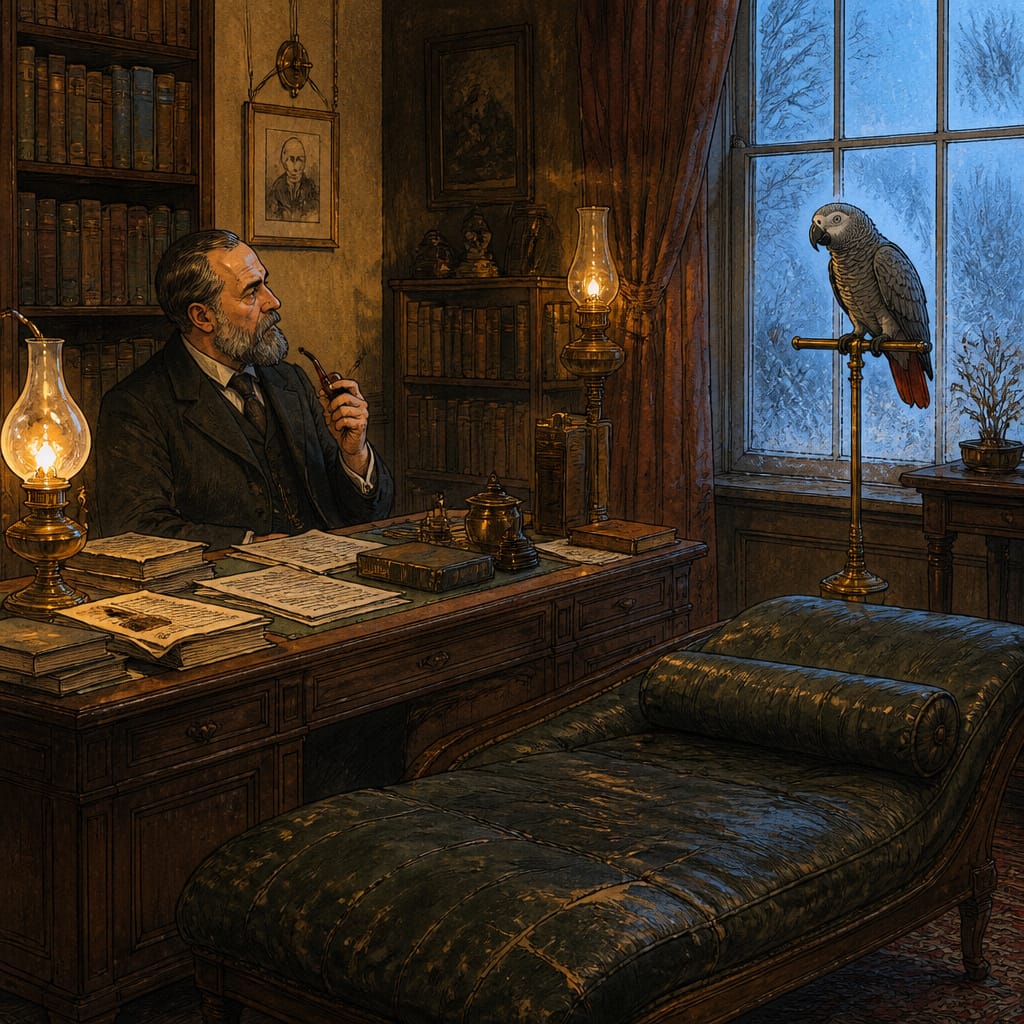
There is a perch near the fire in the back of the bookshop, and on the perch there is a parrot.
He has been there as long as anyone can remember. His name, if he has one, has never been mentioned in this shop. He has opinions about most things, which he keeps to himself, mostly. He is an African grey. His eyes, when they are open, are precisely the colour of old amber, which is to say the colour of something that used to be something else entirely.
He came from Vienna.
This is his story.
In the year 1895, in the fourth district of Vienna, there was a consulting room.
It smelled of pipe tobacco, old paper, and a faint chemical sweetness that was not entirely unpleasant. The furniture was horsehair and mahogany, dark and serious. A chaise longue sat in the middle of the room — not quite a bed, not quite a chair — and patients lay on it and talked, sometimes for years, while the doctor listened from a chair just out of their line of sight.
The doctor was thorough. He was brilliant. He was also, in the autumn of 1895, in a certain amount of trouble.
Not the kind of trouble that shows. The kind that lives behind the eyes.
He had learned his method from a great French doctor who could put people to sleep — truly, deeply to sleep — and speak to whatever it was they kept hidden underneath. This was called hypnosis, and for a time the doctor had believed in it entirely.
The problem was that it didn't always work.
Sometimes the patient simply refused to go under, the way a cat refuses to be picked up: not out of stubbornness exactly, just out of being fundamentally themselves. And if the method failed, the doctor didn't know what to do next. He was a man who very much needed to know what to do next.
The parrot had been in the consulting room for three years. The doctor's wife had received it from a patient who could no longer keep it, and it had ended up on a brass perch near the window, which it preferred to any other location because of the light, and possibly because of something else, which we will come to.
His name, in this household, was Karl.
Karl watched. This is what African greys do. They watch with one eye at a time, and they file away what is emotionally loud, and they do not forget.
On a grey Tuesday in November — Lionel is quite certain about the Tuesday; less certain about the November — a patient came who could not be hypnotised. Could not be put under at all.
The doctor tried everything he knew. He spoke in his quietest, most authoritative voice. He described the heaviness of the eyelids, the weight of the arms, the particular quality of sleep that is not quite sleep. He even produced a small gold watch on a chain and swung it slowly, back and forth, in the manner he had seen described in journals — which he privately considered somewhat theatrical, but sometimes theatrical was what was needed.
Karl, on his perch by the window, watched the watch swing.
He had seen it used before, and he had watched, and he had drawn his own conclusions about it, which he kept to himself. Karl always kept his conclusions to himself. He was not, in the doctor's opinion, a demonstrative bird.
The patient's eyes remained open.
After some time, the patient left, and the room was quiet, and the doctor sat at his desk and looked at nothing for a long moment.
Then he said, in German, very quietly, to no one in particular:
“Es wirkt nicht. Die Hypnose… wirkt nicht.”
Which means: it does not work. The hypnosis… does not work.
Karl, on his perch by the window, turned one eye toward him, and filed it away.
Here is something about African grey parrots that the doctor knew and had momentarily forgotten:
They do not store what is said to them. They store what is said with feeling. The words that go in deepest are the words spoken at moments of weight — grief, fear, relief, the specific exhaustion of a man who has just admitted to himself something he has been avoiding for months.
The doctor had spent three years speaking to patients with tremendous care and considerable restraint.
He had spoken to Karl only when he was tired, or thinking out loud, or when the room was empty and there was no one to be professional for.
Karl had, as a result, a very complete picture of the doctor.
Weeks passed. Other patients came and went. The doctor tried new things — asking patients to say whatever came to mind, uncensored, in whatever order it surfaced. He noticed, to his interest, that this seemed to work better. He didn't know yet what to call it. He was still working that out.
One afternoon in what Lionel believes was December, he was preparing for a session — reviewing his notes, the chaise longue waiting, his chair positioned just so — when Karl shifted on his perch, lifted one foot, tilted his head, and said:
“Braaaawk — die Hyp-no-se… nein… wirkt… nicht. Wirkt nicht.”
In a voice that was not Karl's voice.
In a voice that was, in fact, quite recognisably the doctor's own — his exact cadence, his exact exhaustion, the particular way a brilliant man sounds when he is telling himself the truth he has been keeping from himself for a long time.
The doctor went very still.
He looked at Karl.
Karl looked back. One eye. Then the other. Then he rearranged his feathers and looked out the window, as if nothing had occurred, which, from Karl's perspective, nothing had.
Whether the bird understood what he had said — Lionel won't say. Lionel has his suspicions, as he always does, but Karl has never confirmed them, and Lionel respects that.
What the doctor did next is recorded in the history of medicine, if you know where to look.
He put down his notes. He thought for a long time. Then he began to write.
The words he wrote would, over the following decades, change the way the world thought about what was hidden inside people and why, and what might be done about it. They filled enough books to fill several shelves of a bookshop, in many different languages.
The parrot, as far as anyone can tell, never mentioned it again.
Now.
In the back of the bookshop, near the fire, there is a perch, and on the perch there is an African grey parrot. He is old. African greys live sixty years, sometimes eighty, sometimes — in certain bookshops, under certain unspecified conditions — longer than that.
He has been here as long as anyone can remember. He says very little. When he does speak, the words are always someone else's.
Lionel was tidying the shelf near the fire once, not long ago, and he stopped, and looked at the parrot, and the parrot looked back.
“Oh my,” Lionel said, to no one in particular.
“Is the good doctor still teaching?”
The parrot opened one eye. Considered the question, or appeared to.
Then he closed it again.
— The fire is always exactly the right size. —