The old bookshop smelled the way old bookshops always smell — of paper that had been waiting patiently for a very long time, of dust that had settled so thoroughly it had simply become part of the furniture, and of something else, something harder to name, something that might have been ideas left behind by everyone who had ever read anything in this particular room.
Lionel sat in his chair the way he always sat — heavily, comfortably, the way a very large cat might sit if it had decided that this was its chair and the matter was not up for discussion. The lamp beside him made a warm circle of yellow light. Outside, the night was doing what nights do. Inside, the dust was doing what dust does.
He was holding something.
It was a small book — not much bigger than your hand — with a brown cover gone soft at the corners from being held too many times. The kind of book that had clearly been important to someone, though it didn't look important. It looked, if anything, like it might be slightly embarrassed at how ordinary it appeared.
"Foreman's log," Lionel said, to no one in particular, or perhaps to everyone in general. "Nineteen thirty-four. Black Canyon, Nevada."
He opened it to a page near the middle. Ran one large finger down a column of neat, tired handwriting.
"Most of it is quite dull, as official records tend to be," he said pleasantly. "Concrete poured. Equipment checked. Men accounted for. The usual business of building something that had never been built before."
He paused.
"And then — here — right here between Tuesday's concrete report and Wednesday's equipment manifest — someone has written, in handwriting rather more annoyed than the rest:"
"Damn animal in panel room again. Knocked the gauge log off housing seven. Creature has strong opinions about what ought to be where."
Lionel smiled. Not a small smile. The kind that takes its time.
"Strong opinions," he repeated. "About what ought to be where."
He closed the log very gently, the way you close something that deserves to be treated carefully.
"Now. I should tell you a little about where we're going. Because where we're going is a long way from here — in distance, and in time, and in temperature, particularly in temperature — and you ought to know what you're walking into."
The lamp flickered, very slightly. The dust settled a little more.
"The year is 1934. The place is Black Canyon, on the border between Nevada and Arizona — which is a way of saying it belonged fully to neither and completely to the desert. They are building something there that has never been built before, something so large that the men building it could barely see from one end to the other. They are building Hoover Dam."
He let that sit for a moment, the way you let something heavy down slowly.
"Now. If you were to visit Hoover Dam today — and I rather hope someday you will — you would see a wall of concrete seven hundred and twenty-six feet tall. That is taller than sixty of your fathers standing on each other's shoulders, which is not something your father is likely to agree to but gives you the general idea. There is enough concrete in that dam to pave a road — a proper two-lane road, mind you — all the way from San Francisco to New York City. Every mile of it. Every turn."
"And here is perhaps the most remarkable thing about that concrete."
He leaned forward, very slightly.
"It is still curing. Right now. Tonight, while you sit here. While you sleep later. The concrete in Hoover Dam is still slowly, very slowly, becoming harder and stronger than it was the day before. The engineers who built it estimated it would take one hundred years to fully cure. Which means somewhere around the year two thousand and thirty-six, give or take, that dam will finally be finished becoming what it always was going to be."
"The men who built it will not see that day. But the dam will."
He settled back.
"They built it during the Great Depression. Perhaps you have heard of the Great Depression. It was a time when many, many people had very little — very little money, very little food, and sometimes very little hope. The men who came to Black Canyon came because they needed work, and this was work, and hard work at that. The summer heat in that canyon reached a hundred and nineteen degrees Fahrenheit. That is considerably hotter than any oven your mother has ever used. It is hot enough that the air itself seems tired."
"They were paid between fifty cents and one dollar and twenty-five cents per hour. For the hardest work most of them had ever done. In the hottest place most of them had ever been."
He paused again. Then, quietly:
"They were grateful for it."
"Now. Shall we go there? I think we should go there."
The lamp made its warm circle. The dust drifted. And somehow, without quite moving, the bookshop became a little less present, and a hot Nevada night became a little more so, and Lionel's voice continued, and it carried everything with it —
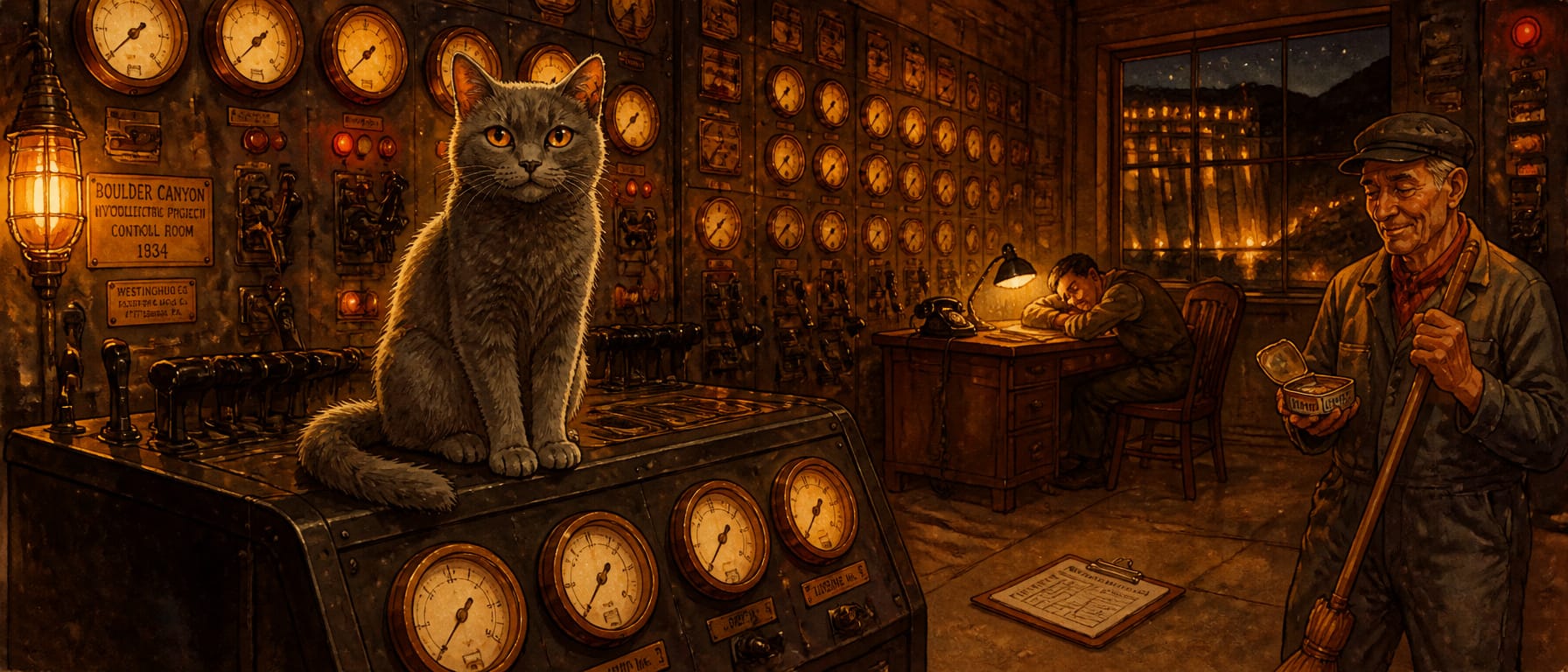
The control room smelled like oil and ozone and the particular kind of heat that has nowhere left to go.
It was not a large room, but it felt large, because every wall was covered — floor to ceiling, corner to corner — with equipment that meant something serious. Brass dials the size of dinner plates caught the amber glow of the indicator lights and threw it back warm and slightly worried-looking. Switches lined the panels in long rows — each one as long as a man's forearm, each one with a heavy black handle made of Bakelite, which was the material serious things were made of in those days: hard, black, slightly warm to the touch, smelling faintly of something permanent.
The indicator lights were amber and red. There was no green. Green came later. In 1934, the lights that mattered were amber for watch this and red for do something now.
The wires running between the panels were wrapped in cloth — canvas, wound tight — because plastic for such things had not yet been invented and the engineers of 1934 used what worked and did not wait for what didn't exist yet. The telephone on the supervisor's desk was black Bakelite and weighed roughly four pounds, and if you dropped it on your foot you would know about it for a week.
The chairs had cast iron casters on a concrete floor.
You could hear a chair moving from the other end of the building. You could hear it from the hallway. On a quiet night, which this was, you could probably hear it from outside. The chairs announced themselves. They had no choice.
At half past two in the morning, the announcing of chairs had stopped some time ago. The day shift was long gone. The night engineer — a careful, methodical man named Garrett who checked his pocket watch rather more often than time strictly required — had fallen asleep at his desk somewhere around midnight with his logbook open and his pen still in his hand. This was not entirely his fault. It had been a very long week and the chair, when not rolling, was surprisingly comfortable.
The amber lights watched over everything with their warm, worried glow.
The red lights stayed quiet.
For now.
In the corner farthest from the door, where the junction of two panel housings made a small sheltered triangle of shadow and the metal was warmest from the equipment running behind it, something small and grey was asleep in a position that suggested bones might be optional.
She had arrived at the dam site eleven months ago in the way that cats arrive at places — which is to say, she was simply there one morning, and then she continued to be there, and eventually everyone stopped wondering how she had got there and simply accepted that she had.
She was not a remarkable cat. She was grey, medium-sized, with a notch in her left ear from an argument she had won some time ago, and eyes the particular amber color of the indicator lights, which may or may not mean anything.
She had no name. Cats at a construction site in 1934 did not generally acquire names. They acquired, at best, a reputation.
Hers was for having strong opinions about where things ought to be.
Now, up the canyon, in the camp where the men slept, there lived a dog. Everyone knew the dog. He was the camp's own — a big, friendly, dust-colored fellow with one ear that flopped and one that didn't, who had worked out early in life that a wagging tail and a hopeful expression could earn a man's last bite of bread about nine times out of ten, and who spent his days going from shift to shift collecting exactly that. He had a name. The men had given it to him gladly, the way you give a name to a thing you have decided to love. He slept in the sun with his paws in the air. He was scratched behind the ears a hundred times a day, and a hundred times a day he believed it was the first. If you had asked any man on that dam who the most important animal in Black Canyon was, he would have laughed, and pointed at the dog, and he would not have been wrong.
Down in the control room, in the warm triangle of shadow behind panel seven, the grey cat slept, and no one pointed at her at all.
She discovered the control room in her second week at the dam site, drawn by warmth and the high thin singing that the equipment made when it was running, a singing that no human ear could quite hear but that she felt very clearly in the pads of her feet and in the place behind her sternum — the sternum is the flat bone that runs down the very center of your chest; press there, gently, and you will find it — the place where important information arrived unannounced.
The equipment sang one way when everything was right. She knew that song. She had learned it the way she had learned everything — by paying attention.
It sang differently when something was not right.
Guillermo arrived at twenty past two every working night, pushing a wide broom that had seen considerably better days and which, in the amber light, looked rather as though it had been liberated from someone who would have preferred to keep it.
He was a small, quiet man who had come to Black Canyon from El Paso with seventeen dollars and a letter of reference that had gotten slightly damp on the journey and was consequently harder to read than it might have been. He had been hired anyway. He swept the control room, the corridor, and the equipment bays. He was paid less than the men who read the dials.
He did not complain about this. Complaint was a luxury, in 1934, that cost more than most people could afford.
At twenty-five past two, he reached the corner of the room nearest panel seven, set his magnificent broom against the wall, and opened his lunch pail.
The lunch pail contained, on this particular night: one biscuit, somewhat flattened by the journey; a small tin of sardines; and an apple that had decided somewhere between Boulder City and Black Canyon to become more philosophical about its condition.
He looked at the sardine tin for a moment.
Then he looked at the corner where the grey cat was pretending to be asleep with the focused intensity that cats bring to pretending.
He opened the tin. Tore off a corner of one sardine — not a large corner; this was supper, not charity, except that in the dividing of it, it became a little of both — and set it on the concrete floor near the base of panel seven.
He did not say anything. He was not a man who narrated his own actions.
The cat did not immediately move. She waited a dignified interval of approximately four seconds, which is quite long for a cat, and then moved to the piece of sardine with the air of someone who had been intending to come over here anyway and had not been waiting at all.
Guillermo ate his biscuit and watched the dials.
The amber lights watched with him.
There were other men on the night shift, you understand, and other suppers. The engineers had thick sandwiches their wives had wrapped in waxed paper; the foreman kept a tin of good crackers in his desk drawer; and now and then one of them would flick the grey cat a scrap the way you toss away a coin to be rid of it. She ignored them. She ignored them completely. But she did not ignore Guillermo. Of all the men in that canyon — the ones who read the dials, the ones who signed the papers, the ones whose names would go into the records — the cat had chosen the small quiet man with the borrowed broom, the one nobody would ever think to write down. Why him? Cats, as you have perhaps already begun to suspect, do not answer questions like that. But she came to his corner every night, and she sat near him while he ate, and she let him be the one to feed her. That was its own kind of answer, if you were the sort of person who paid attention. Guillermo was that sort of person. He usually was.
It was at twenty minutes to three that the cat stopped eating.
She had been sitting beside panel seven — not on it, not yet — washing her face in the thorough, methodical way cats wash when they are thinking about something else. She stopped. Her head came up. Her ears, which were excellent ears with a small notch in the left one, turned forward and then slightly to the right.
She looked at the panel housing.
The equipment was singing.
It was not singing the right song.
This was a thing she knew the way she knew where the warmest corner was, and where Guillermo would be at twenty-five past two, and where the mice that lived in the cable conduit ran when they thought no one was watching. She knew it in her feet and in the place behind her sternum. The song was wrong. Something behind that panel, in the dark complicated world of switches and relays and wires wrapped in canvas, was doing something it ought not to have been doing, or not doing something it ought to have been.
She looked at the panel for a rather long moment.
Then she jumped up onto the housing.
The panel housing was broad and flat and warm, which were three qualities she approved of in a surface. It also had, along its upper edge, a row of secondary indicators — smaller dials, brass-rimmed, with thin needles — and beside those, a gauge log: a clipboard holding the night's readings, balanced on a small metal bracket that was perfectly adequate for holding a clipboard, and perhaps slightly less adequate for also holding a medium-sized grey cat.
She walked along the housing with the careful, deliberate tread of someone conducting an inspection.
She reached the gauge log.
She looked at it.
She pushed it off.
The clipboard hit the concrete floor with a sound that was, in a quiet control room at twenty minutes to three in the morning, extremely loud.
Garrett woke up so suddenly that his pen flew across the desk and his pocket watch, which he had been holding in his sleep like a small round worry stone, nearly followed it. He sat up, blinked at the room with the expression of a man trying to remember which reality he had left off in, and focused on the grey cat sitting on panel seven regarding him with amber eyes and no particular apology.
He said something that probably should not be written in a book that children will read.
He stood up. He walked to panel seven, picking up the clipboard on the way, muttering about animals and proper facilities and what his supervisor would hear about this in the morning.
He was still muttering when he happened to glance at the secondary indicators.
He stopped muttering.
He looked at the dial on the far right. He looked at it again. He looked at the clipboard in his hand, found the previous hour's reading, and looked back at the dial.
He became very still in the way that careful, methodical men become still when they are thinking something through very quickly.
Then he went to the telephone — the four-pound black Bakelite telephone — and made a call that woke someone up who was not very pleased about it until Garrett told him the number on the dial, at which point the being-woken-up became considerably less important than several other things.
In the corner of the room, Guillermo watched this with the quiet attention of a man who has learned that watching carefully costs nothing and sometimes tells you a great deal.
The grey cat stepped down from panel seven, walked back to the sardine tin, and finished what was in it.
She had, after all, been interrupted.
"The official report," Lionel said, his voice coming back warm and unhurried into the amber-and-dust world of the bookshop, "notes that a pressure irregularity in the secondary relay system was identified and corrected during the night shift of November fourteenth, nineteen thirty-four. It praises Engineer Garrett for his alertness and careful attention to instrumentation."
"Engineer Garrett received a commendation."
"Guillermo is not mentioned in the official report."
He held the foreman's log very gently.
"The cat receives exactly one mention, in handwriting considerably more annoyed than anything else in the document:"
"Damn animal in panel room again. Knocked the gauge log off housing seven. Creature has strong opinions about what ought to be where."
He set the log down.
"They buried the dog, you know. Right there near the visitor center. You can go see it today if you like. Lovely gesture. The dog was much beloved."
"But I've often wondered — and perhaps you will too — whether there might ought to have been a second marker. Somewhere near panel seven. Small one. Nothing fancy."
"A cat's name, if anyone had thought to give her one."
He settled back into his chair. The lamp made its warm circle. The dust continued its patient work.
"Now. The concrete in that dam is still curing tonight. Growing stronger, very slowly, the way things do when they are built to last."
"And as most cats do, that particular cat seemed to have very strong opinions about what buttons should be pushed and when."
"Whether she had her reasons —"
He smiled.
"Well. Cats rarely explain themselves."
"Goodnight."
— The fire is always exactly the right size. —